Hack the Harvest
Can you tell what happened in a cornfield from space?
A two-day interdisciplinary hackathon exploring how satellite imagery and GPU-powered analysis can deliver faster, more accurate commodity crop projections than today’s survey-based process. Your starting challenge: distinguish silage corn from grain corn using publicly available geospatial data.
November 14–15, 2026 | Aggie Square, Sacramento, CA
200
Student Places
5–7
Students per Team
22.5h
Build Window
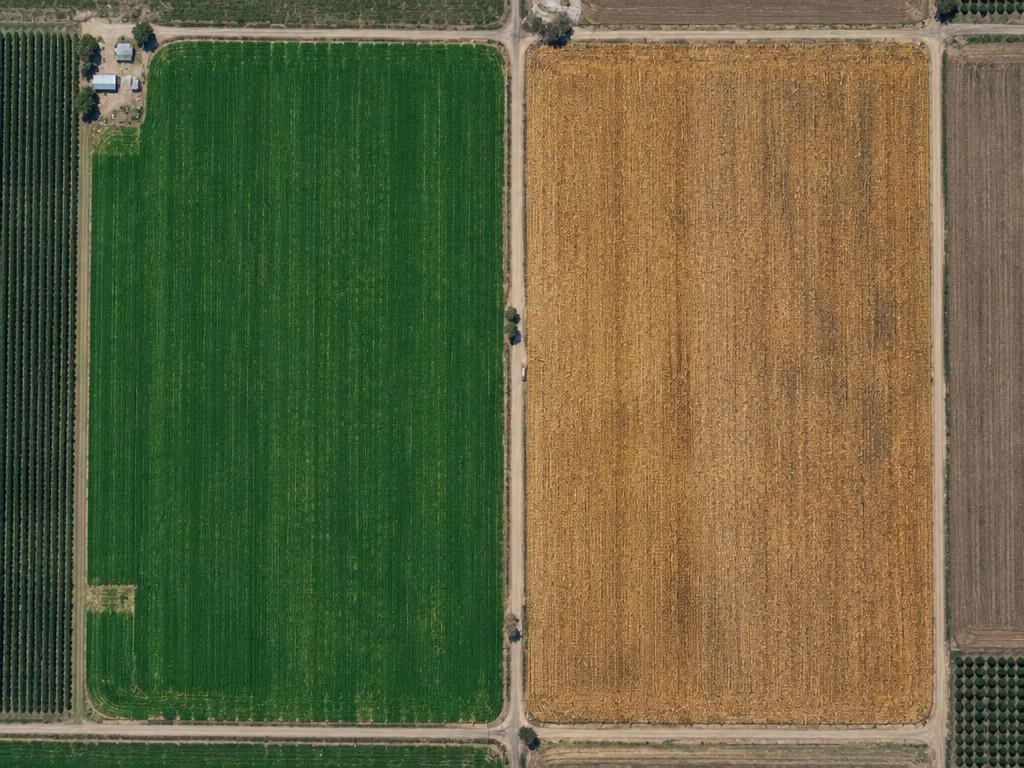
Typically harvested earlier, while green
Generally harvested later, after dry-down
In Collaboration With

Challenge Provider
Academic Host
Technology Partners
Technology Partners

Technology Partners

Powered By
The bigger goal: better crop projections.
Use satellite imagery and GPU-powered analysis to work toward faster, more accurate commodity crop projections than today’s survey-based process.
The Challenge
How can we tell from the sky whether a cornfield was harvested for silage or for grain?
Your task is to distinguish cornfields harvested for silage from those harvested for grain using only publicly available geospatial data. Identifying how a crop is harvested is a concrete step toward the broader crop-projection goal.
The core problem is detecting subtle differences in crop growth and harvest patterns from afar. The signal may be subtle, noisy, and easy to miss. But it is there.
Key insight
Silage corn is typically harvested earlier, while the crop is still green. Grain corn generally remains in the field longer as it dries down before harvest.
One shared USDA challenge. Different ways to solve it.
There is no single prescribed approach.
Approach 01
Changes Over Time
Look for changes in vegetation and compare satellite imagery across harvest windows.
Approach 02
Patterns in the Data
Combine public datasets, build field-level time-series models, or identify spectral and temporal signatures.
Approach 03
An Answer People Can Use
Develop a classification model, create an interpretable visualization, or find a completely different signal.
The challenge is yours to solve.
Who Should Hack?
You don't have to be a coder to hack the harvest.
We are looking for teams with different ways of thinking.
Engineers
Build the pipeline.
Work with sensors, systems, algorithms, computation, and technical implementation.
Data Scientists
Find the signal.
Analyze geospatial and time-series data, develop models, and test hypotheses.
Business & Management
Define the problem.
Develop strategy, identify opportunities, communicate insights, and think about practical value.
Open to undergraduate, graduate and doctoral UC Davis students across disciplines, including agriculture. Teams of 5–7 form before the event.
Bring one. Find teammates who bring the rest.
What You'll Work With
Public data, local insight, and a sharp question.
Satellite Data
Earth-observation imagery and publicly available satellite datasets.
Crop & Agricultural Data
Public datasets describing crops, fields, and agricultural activity.
Geospatial Data
Maps, field boundaries, geographic information, and spatial patterns.
Time-Series Analysis
Look for changes in fields over time and identify harvest signatures.
AI & Machine Learning
Build models or analytical methods to distinguish silage from grain.
Creative Problem Solving
Find unconventional signals or combine multiple public datasets.
You do not need to be an expert in every one of these areas.
Why This Matters
A small difference. A big question.
Agriculture is happening all around us, but much of it can be difficult to observe at scale. Satellites and open data give us a new perspective: the ability to observe patterns across thousands of fields without being physically there.
Your job is to turn those observations into an answer.
Event Platforms
Where the event happens online
Devpost
Registration, team formation, project and video submissions, and judging.
Keeboh
Technical workspace and challenge resources.
Discord
Announcements, team coordination, and scheduled support.
The Hackathon Experience
Two days. One real challenge.
Draft schedule. All times Pacific.
Aggie Square event operations run 8 a.m.–4 p.m. both days. Participant check-in begins Saturday at 9 a.m.; teams are expected back Sunday by 10 a.m. The official build window is Saturday 10:30 a.m.–Sunday 9 a.m. (22.5 hours).
Pre-event orientation
Approximately one week before the event, a one-hour online orientation will cover the challenge, Keeboh, Devpost submissions and questions. Background materials, prior-work summaries, starter notebooks and access instructions will be shared in advance. Timing and session details will be announced once confirmed.
Prepare your team, read the background materials and test access in advance. No competition work may begin early. Work on competition solutions, challenge-specific model training and judged deliverables begins Saturday at 10:30 a.m.
Saturday, November 14 | Aggie Square
Discover & Build
4480 2nd Ave, Sacramento
9 a.m.
Check-in opens: refreshments and partner booths
10:30 a.m.
Your 22.5 hours of building begin
12:30 p.m.
Lunch with partners
3 p.m.
Overnight workspace opens at the Courtyard by Marriott Sacramento Midtown
Sunday, November 15 | Aggie Square
Build & Show
4480 2nd Ave, Sacramento
9 a.m.
Submissions close in Devpost
10 a.m.
Back at Aggie Square for sponsor sessions and career conversations
11:30 a.m.
Every team member present; finalists announced
12:15 p.m.
Live finals begin
1:50 p.m.
Awards and closing (awards may start as late as 2 p.m.; done by 2:30)
Between milestones, the time is yours to build, get mentoring and meet partners.
Overnight | Keep Building
The overnight workspace is at the Courtyard by Marriott Sacramento Midtown, 4422 Y St, Sacramento, CA 95817. It is open from Saturday at 3 p.m. through Sunday submissions at 9 a.m., followed by pack-up and return to Aggie Square from 9–10 a.m. Participants arrange their own transportation.
Mentoring and technical support will combine scheduled on-site and remote availability, with event updates and support coordination through Discord.
Sunday attendance requirement
Teams are expected back at Aggie Square by 10 a.m. To remain eligible for overall awards, every team member must check in individually and be present at Aggie Square by 11:30 a.m. Finalists must be ready at 12:15 p.m., and teams must remain through the awards ceremony. Emergency or accessibility exceptions require approval from the event lead.
Submissions & Judging
Show your work clearly.
Submit your project and a demo or pitch video of no more than three minutes through Devpost by Sunday at 9 a.m. Four eligible teams advance to the live finals, with seven minutes to present and three minutes for questions.
Final judging rules and prize details will be shared before the event.
Draft rubric
Award categories and prizes will be announced once confirmed. A separate NVIDIA Nemotron award is proposed, subject to confirmation. Nemotron use is optional for the overall competition.
FAQ
Before you arrive
Who can participate?
Undergraduate, graduate and doctoral students across disciplines, including engineering, computer science, data science, business, management and agriculture. Open to UC Davis students only.
Do I need to know how to code?
No. Teams benefit from a mix of technical, analytical, business and creative skills.
Do I need prior satellite-data experience?
No. Background materials, starter notebooks and a pre-event orientation will help participants prepare.
Do I need a team?
Teams of 5–7 form before the event. Team formation will be coordinated through Devpost. Team guidance will be shared with registration.
What data can we use?
Publicly available geospatial data. Challenge resources and technical instructions will be shared before the event.
Can we start early?
Background reading, team formation, account setup and access testing with designated practice examples are allowed in advance. Competition solutions, challenge-specific model training and judged deliverables begin Saturday at 10:30 a.m.
Where do we work overnight?
The overnight workspace is at the Courtyard by Marriott Sacramento Midtown, 4422 Y St, Sacramento, CA 95817. It is open from Saturday at 3 p.m. through Sunday submissions at 9 a.m., followed by pack-up and return to Aggie Square from 9–10 a.m. Participants arrange their own transportation. Scheduled on-site and remote mentoring will be coordinated through Discord.
What do we submit?
A project and a demo or pitch video of no more than three minutes through Devpost by Sunday at 9 a.m.
When must we return Sunday?
Expected return is 10 a.m. Every team member must check in individually and be present by 11:30 a.m. to remain eligible for overall awards, and teams must remain through the awards ceremony. Emergency or accessibility exceptions require approval from the event lead.
What about prizes and Nemotron?
Award categories and prizes will be announced once confirmed. A separate NVIDIA Nemotron award is proposed, subject to confirmation. Nemotron use is optional for the overall competition.
What should I bring?
A laptop, charger, curiosity and willingness to experiment.
Can students from other institutions participate?
No. The event is open to UC Davis students only.
The Harvest Is Happening.
The question is whether you can see it from space.
Registration is open on Devpost. Form your team of 5–7 and register before the event.
Register on Devpost200 student places. Teams of 5–7, formed before the event.